Showing posts with label Transgender debate. Show all posts

April 24, 2026

No, Vlad, defending trans people does not weaken pro-climate policies

Vlad Vexler, who is normally known as a well informed and sensible political commenter, now wants to sacrifice  the defense of trans people to save the climate movement. A nonexistent problem becomes trans erasure in a new video.

Vlad Vexler is a Russian born British philosopher, political analyst and YouTube essayist, best known for his commentary on  Putinism, democracy, populism, authoritarianism, political philosophy and culture. In the video he is talking to Rupert Read, a British philosopher, environmental campaigner and public intellectual. [Update: The video has been taken down].

Are trans people scaring good people away?

It is a bit disturbing to see two cis white men talk intellectually about sacrificing Black and trans people on the altar of  climate change victory, as if these were somehow completely different topics, and not the end result of a coherent and systemic world view that makes the exploitation of both nature and people seem natural and benign.  

In an article over at Resilience, an environmental and social-change publication run by the Post Carbon Institute, the two of them put it this way:

'Second, calls to “center the Global South” translated into expectations that Western participants should express collective guilt, defer to non-Western voices and adopt hyper-‘progressive’ immigration positions that command relatively little civic support across the West. Third, a similar dynamic emerged over trans rights, with members often expected to affirm contentious claims – for instance, that trans women are indistinguishable from biological women across all contexts, including sport, prisons and debates about male-on-female violence. As a result, even those broadly supportive of racial justice, global justice and trans rights could feel excluded unless they endorsed the approved formulation.'

No one says that trans women are indistinguishable from "biological women" (which is a dubious and unscientific term in itself).  What trans activists and their supporters are saying is that trans women are women and that they should be given the same human rights protection as everyone else. They should have the same right as everyone to live their lives in peace and with the same liberties as everyone else.

Indeed, given that trans people represents a small marginalized group targeted by fascists and fundamentalists, pro-democracy humanists have to pay special attention to their needs. What extremists  do to their favorite scapegoats, tell us  a lot about their overall strategy for achieving hegemony. 

Every argument made in this paragraph reflects the anti-trans movement's attempt to dehumanize and scapegoat trans people.  None of the "problems" presented in the article reflect serious, real, on the ground challenges for the climate crisis movement, as I see it.

Vlad even plays the "I like trans people, but...." card in this video, promising to defend trans people in the future. He would have had more credibility if he had made a knowledge based, compassionate, defense of trans people first. 

Vlad Vexler and Rupert Read

Supporting trans people does not undermine  support for green politics

The MAGA regime is not persecuting trans people because it makes them popular. 

The fact is that the great majority of Americans sympathize with trans people, even though some disagree with some policies. (Nor do they like the extreme violence against immigrants.) 

March 27, 2026

Are you a man or a woman?

Someone says to a transgender person "but you were born a man!" and my head wants to explode. No one is born a man or a woman, but instead male or female with the added non-negligible array of intersex conditions and ambiguous genitalia which leaves us unable to instantly pick a binary designation at birth. All this because nature abhors uniformity. 

Guest post by Joanna Santos

It turns out the perfect binary never truly existed but the idea was created and maintained to suppress any natural human gradations found everywhere else in biological processes. 

If we base ourselves exclusively on science this perfect binary isn't real. It was a cultural artifact where religious leaders and the ruling class could have the predictability they needed, and for most people it worked if imperfectly. 

Tolerance or intolerance?

Many native cultures have tolerated and even embraced those who exhibited gender variance. Others, more steeped in orthodoxy, fought it vigorously as it contradicted dogma that couldn't contain flexibility. 

People in those latter cultures with the most need to transition, were obliged as much as possible into stealth. Even variations of expression were discouraged to the point of physical arrest and incarceration well into the 20th century. 

June 27, 2024

A sidebar on what it means to be transgender


The Crossdreamer Sidebars blog  has been my blog for more in depth discussions related to writings on this, my main blog. I have ignored if for too long. I am resurrecting it with a post on what it means to be transgender.

Over and over again I have found that gender variant people get lost in discussions about what it means to be trans, because there are so many different ways of defining the terms. Indeed, there are even trans people who try to control the discourse by making the defininition of the term trans as narrow as possible.

I will continue to defend the original understanding of trans,  the one becoming dominant in the 1990's. According to this understanding transgender is an umbrella term for all kinds of gender variance.

Transgender is therefore not a term that refers only to those who desire to transition or who have transitioned from one gender to another gende.  It is not limited to those who used to be called transsexuals, and it does not require that you experience gender dysphoria.

More about my understanding of the word transgender over at Crossdreamer Sidebars.

PS: The sidebar blog has also gotten its own domain name. This has, apparently, a big effect on search engine rankings.

Photo: Piksel

September 22, 2023

Anti-LGBTIQ literature in the Spanish language


There is a serious lack of online resources on anti-LGBTQ activism in the Spanish language. Queer and transgender people need to know who these people are, their way of thinking and their tactics if they want to stop them from doing more harm. 

The first post of our new Spanish language blog, Mundo LGBTIQ,  is therefore on "Anti-LGBTIQ literature written in Spanish". 

Here follows an English language translation of that post. The original can be found here.

By Amilka González

The Spanish language is the second most spoken language in the world by natives, with almost 500 million speakers.In recent years many Spanish-speaking groups have become increasingly committed to the dissemination of discourses that question the human rights of the LGBTIQ population, which raises the need to map both groups and discourses. This would be the starting point for analyzing transnational relations and alliances between Spanish-speaking anti-rights groups and Spanish speaking anti-rights group.

It can be said that dedicating the first article of our new Spanish language blog to anti-LGBTIQ rights literature is giving undeserved publicity to ideas that are harmful to society. However, if we want to understand how these ideas work and why they are shared by many people, we believe it is necessary to map these discourses.

This is not a novel idea. It is a strategy known to anti-racist organizations that for decades have monitored hate speech related to racial segregation and other types of discrimination. An example of this is the Southern Poverty Law Center, based in the US, which has been dedicated to this work, in addition to being known for its legal battles against supremacist groups.

June 24, 2022

New Norwegian survey shows increased public support for LGBTQ+ people, trans people included

Over 70% of Norwegian women think it is OK to share a locker room with a transgender person.  Over 60% support gay, lesbian and bisexual people, while some 50 percent express support for transgender people. The support for queer people is increasing. That is not bad, the current anti-LGBT activism considered.

[UPDATE: Click here for an update on the recent terrorist attack against Oslo Pride and what that may mean for Norwegian support of queer people].

LGBTQA+ issues have become weaponized in what some refer to as "the culture war." In many ways we see a repeat of the way queer people were used as a threat in the mid-war period, when especially Fascists and Nazis presented gay and gender nonconforming people as a threat to the social order and the common man. 

"Gender critical" TERFs (trans-exclusionary radical feminists) and right wing extremists have now come to the point where they want to force trans people back into their closets. In countries like the USA, Russia, Poland and Hungary, the extreme right are going after all queer people, and not only those trans. 

An important question is therefore whether this kind of hate activism reflects broader trends among the population as a whole or whether this is more about extremists making a lot of noise, with little effect on the attitudes found among people in general.

A recent British study shows that Brits in general are very LGBTQA-friendly, and that a majority feel an admiration for trans people. 

Given the intense anti-trans activism of transphobic British TERFs, right wing fundamentalists and the media in that country, the British numbers may indicate that the trend towards increased acceptance of queer people has a fairly strong fundament, in the sense that the many  countries continue to move towards greater  LGBT+ acceptance.

The Norwegian survey of public attitudes towards LGBT+

The Norwegian Directorate for Children, Youth and Family Affairs (Bufdir) published an updated version of its survey of people's attitudes towards what they refer to as "LGBTIQ" people earlier this week. This provides an interesting case of shifts in attitudes in one country.

June 9, 2022

"The TERFminator" – Lesbian feminist LGBTQA-activist puts "gender critical" transphobes in their place


The lesbian feminist and LGBTQA-activist Brita Møystad Engseth argues strongly against the transphobia of "gender critical" feminists.

As the transphobic hysteria grows more intense it becomes harder and harder for "gender critical radical feminists" or TERFs to hide the fact that they are using the exact same arguments as the extreme right.

The British TERF Helen Joyce now argues that anti-trans activists must harness the power of the state to reduce the number of transitioning trans people. This is basically a call for the erasure of trans identities.

The TERFminator

Birta Møystad Engseth (56), a Norwegian lesbian feminist and queer activist does understand the threat the TERFs have become to the queer community and the rest of society.

In an interview published in  the Norwegian LGBTQA magazine Blikk she is presented as "the TERFminator", because of her relentless campaigning against the destructive activisms of the TERFs.

"I cannot waste the rest of my life being silent," she says.

April 8, 2022

What does the word "gender" really mean?

The main problem with the term gender is that it is not referring to one phenomenon only, but many. It is this ambiguity of language that makes discussions so confusing. But it also this complexity that makes the topic so interesting. 

The reason for this ambiguity is that the language most people use today has been developed within a culture that requires you think of male and female as "natural" and mutually exclusive. Moreover, these concepts of male and female are supposed to determine everything you are or can do.

However, reality does not care. Nature does not care. And everyone violates these rules on a daily basis. Everyone!

Here are the most important phenomena referred to as "gender":

Biological sex


Biological sex refers to what is called "gametes", as in sperm and egg. Gametes are real, so biological sex is real. 

Still, the two sexes are not mutually exclusive. Nature throws a lot of dice that comes up intersex, with different chromosomes (as in XY women and XX men) and a wide variety of ambiguous genitalia and sex characteristics.

Many species reproduced by way of gametes, as in human sperm an eggs. Other species have other ways of continuing the species.


By the way: Not even post-modernist gender philosophers deny the existence of gametes.  They are simply pointing out that our understanding of what the existence of biological sex means for our daily lives is colored by culture, and that the scientists themselves are also influenced by culture when they develop and present their theories. 

They are right about this, and scientists may also change their views based on new concepts and new ideals developed elsewhere. Homosexuality and gender dysphoria are, for instance, no longer seen as mental illnesses.  
Note also the way transphobes try to present  the statement "gender is the same as biological sex" as science. That statement represents, at best, 19th century science. I know of no serious scientists today – whether they come from the natural sciences or from the social ones – that argue that the complexity of cultural gender can be reduced to gametes, genitalia or chromosomes. 


Cultural gender


Throughout the ages various cultures have created an insane number of social rules as to how men and women should dress and behave. A Roman man would not be caught dead in trousers. Most cis/het American men today will not be seen in a toga ("Eeeeek! A dress!!!)

February 4, 2022

Why words like queer and trans make perfect sense


Yes, umbrella terms like queer and transgender make perfect sense, but maybe not for the reasons many think.

You have probably heard the questions: “Being gay is about sexuality and being trans is about gender identity, so why do the two belong to the same queer community?"

Or: “Trans men and women suffer from gender dysphoria, while drag queens and ‘crossdressers"‘ are just ‘performing’,” so why should being trans be a matter of gender expression instead of identity only?”

Setting the false premise of  “all crossdressers are just performing” aside, these questions are based on a fundamental misunderstanding, namely that membership in the queer and trans communities need to be based on some kind of easy definable common “essence”. 

In the case of “queer” some would argue that that would be sexual orientation, I suppose, and in the case of "transgender," gender identity or gender dysphoria.

I am not denying that there may be biological components to the development of queer and trans identities. In fact, I think it is hard to explain the existence of queer and trans people without such components, given the severe social conditioning found in societies where the cis/het (cisgender and heterosexual) ideal is the norm. Why would anyone chose to be queer or trans, given the kind of harassment we see?

 Yet, I do not think we – or science – have come to a point where such factors can be used to define social groups. Moreover, such litmus tests, if possible, would without doubt be used to invalidate some trans people, which is not a good thing.

In spite of this lack of reliable "DNA tests" for transness and queerness the existing LGBTQ+ and transgender communities represent meaningful alliances. Broad terms like queer and trans make sense at the moment we move from some kind of "objective" idea of what people essentially are over to the social scene. 

August 31, 2020

Another Way of Understanding The Diversity of Transgender Lives


Koloa presents a model for MTF transgender people that helps us understand how personality traits may explain why trans people take different paths on their trans journeys.

The two type model for transgender women

One of the most important lessons I have learned when writing about trans and queer issues, is to make sure that we distinguish clearly between between the terms and the model you use to understand the world on the one hand, and reality on the other.

As most well informed philosophers will tell you: We do not have direct access to "reality in itself". All we have access to is our own interpretation of our world. So when we see patterns in the world around us, we should always ask ourself: Is this pattern only a mirage produced by my own mind? Is it simply a reflection of my personal prejudices? Are there other models and terms that may explain what I see in a better way?

Since this is a blog covering transgender and queer issues, an obvious example of how badly this can end, is the way the two type typology of transgender women has been used to invalidate them. 

Many researchers have noticed that trans women who come out and transition late are more likely to be gynephilic (being attracted to women) than those who come out as trans at an early age. This has, until quite recently, been quite true on an aggregate level.

August 23, 2020

Zagria on Transgender History 3: Key Transgender People and “The Tipping Point”


Zagria is the researcher, writer and editor behind “A Gender Variance Who’s Who”, the most extensive repository for transgender history on the web. In part 1 of our interview we talked about how she does her research. In part 2 we discussed key concepts of gender variance. In this part we ask her about trans people who have influenced her thinking. We also look at recent political and cultural trends, including the increased visibility of transgender men.

April Ashley, transgender Vogue model and actress in the 1950s and 60s. Photo Ken Walker.

Most influential transgender person


If you were to pick one person from transgender history who has influenced you the most, who would that be? And which trans and  gender variant persons are the most underrated, as you see it?

There was no internet when I transitioned in the 1980s. The most famous trans women were performers such as Coccinelle and April Ashley. I never thought that I was going on the stage. So there is no one such person. I was influenced in many things large and small by the individual cis and trans women whom I knew. 

Some trans persons have been overrated, as I see it. Overrated does not mean that they did not achieve anything. It means that a lot of attention has been directed to them while other people who have done as much or more are ignored.

The following have been given a lot of press and academic attention. They don’t need more. The attention would be better directed to those in the underrated list.

Some examples of those overrated: John Radcliffe-Hall, Gertrude Stein, Lili Elevenes (Elbe), Caitlyn Jenner, Major Griffen-Gracy, Sylvia Rivera, Virginia Prince, Jack Bee Garland, Susan Stryker.

Underrated:  Most activists etc in South America, Asia, Africa and Eastern Europe. North America/Western Europe is well reported, but at the cost of the rest of the world.

Some underrated individuals: Barbara de Lamere, Masha Bast, Janine Roberts, Diana Sacayán, Simone Heradien, Lakshmi Narayan Tripathi. Sally Mursi, Yollada Nok Suanyoy, Rachel Webb, Toni Ebel, Demet Demir, Marie André Schwidenhammer, Chloe Dzubilo, Johnny Science, Brenda Lee, Marcello Di Folco, Alejandro Portadino. There are many, many more.


August 18, 2020

Zagria on Transgender History, Part 2: Key Concepts and Terms

Zagria is the researcher, writer and editor behind “A Gender Variance Who’s Who”, the most extensive repository for transgender history on the web. In part 1 of our interview we talked about how she does her research. In this part we ask her about her understanding of key concepts like transgender and gender variance.

Part 1 of the interview can be found here.
Transgender historian Zagira (private photo)

The word "transgender"


Your site is very inclusive. You explicitly refer to gender variance in the name of the blog, instead of transgender people. 

Could you say something about how you see and understand the transgender community, and the development of the terms used to describe it?

I wrote an extensive discussion of the history of the word Transgender and pointed out five distinct meanings of the word:


1. To change gender full time, but without surgery.

2. As a synonym of transsexual, e.g. in the expression ‘transgender surgery’ (which turns out to be an early usage). Given that transsexuality is not a sexual orientation and that it is more a matter of gender.

3. Rejection of the gender binary. This has a definite history, and was articulated by Gay Lib, etc. and encompasses gender queer, non-binary, street queens etc. Such persons were generally rejected both by gays concerned to be gender normative and by people such as Virginia Prince with their false-consciousness concepts of respectability.

4. At least as far back as Magnus Hirschfeld there has been a need for an umbrella term for all who do not conform to the expectations of their birth gender. Harry Benjamin designed a scale. Leslie Feinberg and others proposed the term ‘transgender’ as an umbrella term, and it has been generally accepted since.

5. As a rejection of the medical pathologization implicit in ‘transsexualism’ and ‘gender dysphoria’. As an articulated usage, this is associated with queer theory, but the implicit attitude goes back to the early days of Gay Lib. Some of the anti-transgender people, especially those who identify with HBS or Truscum [i.e. communities of transsexual separatists], actually affirm themselves as having a medical condition.

In some ways Trangender is a good word because it is polyvalent, it has a richness of meanings. However – particularly when discussing pre-1950 and more so previous centuries – the term has baggage that is better avoided.

It is also damaged by boundary disputes. Some of the people are said by other people not to be transgender: drag performers, femmiphilics, cross-dreamers, gay transvestites, ‘female husbands’, butch women, non-binaries etc.

The Transgender Historian Zagria, Part 1: "A Gender Variance Who's Who"


Zagria is, as far as I see it, one of the most important transgender historians around. She is running “A Gender Variance Who’s Who”, an amazing repository for transgender history. The site contains a large number of posts, over 1500, about transgender and gender variant people from all over the world, spanning centuries.

We talked with Zagria about the site, her work and important transgender issues. Here follows part 1 of the interview.

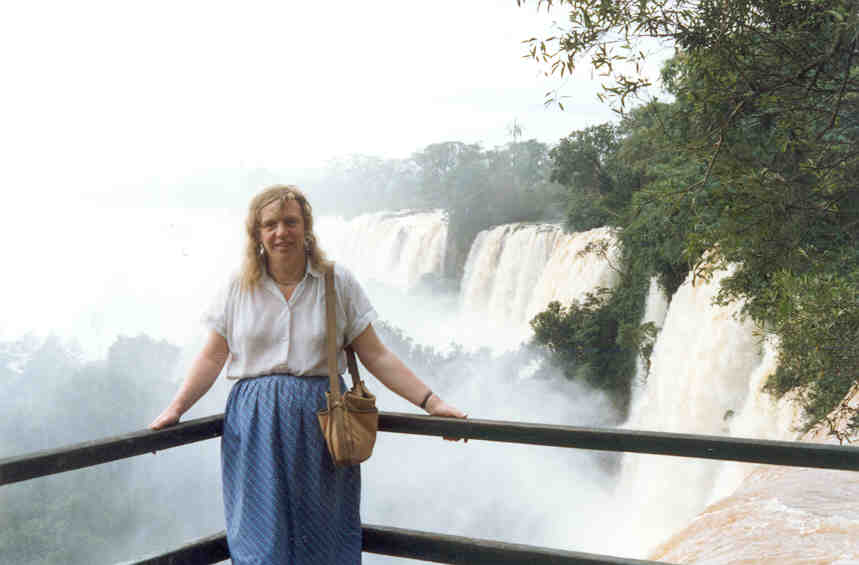
(Above: Private photo of Zagria at Iguazu Falls in 1989)

A site about transgender history


How did you come up with the idea of starting a site about transgender history?


A major influence was Kay Brown’s Transsexual, Transgender, and Intersex History web site. I quickly noticed the narrow range, but thought that the basic idea was good. I had made an HTTRACK [web site copier] copy so could still refer to it when it was taken down.

Now of course it is available to all via the Wayback Machine.

I cannot help thinking that finding information about all these transgender and nonbinary people, and writing about them, must require a lot of research. How do you identify the people you are writing about, and where do you find the information you need?

Yes, a lot of research indeed. Basically I read widely. Sometimes while researching A, I encounter B, and follow up B and encounter C. I find inspiration from books, news articles, academic journals, academic theses, the internet, gossip, history, transphobic sites etc.

It is nice to discover someone while reading a book not about trans history at all. Such as Dudley Clarke, whom I discovered in a biography on the mid-twentieth-century popular novelist Dennis Wheatley, Charlotte Bach whom I discovered in Colin Wilson’s Mysteries, or the trans candidates for being Jack the Ripper.

There is a lot more information out there than there was 13 years ago. Google even suggests which books discuss a person or topic. However the amount of data is itself a growing problem, and results in a lot of reading before I can write something.

Access to journals


As I am not associated with a university, access to journals was a problem. An academic friend allowed me to use his library ID and I was thereby able to access journals until he retired and the ID stopped working. 

 However these days almost all journals and even many books are available via TransReads, LibGen, Academia.edu, ResearchGate, Erudit, etc. Increasingly academic theses are available online, and older ones were available – until recently – at the UCalgary Gay, lesbian, Bisexual, Queer, Transgender & Two Spirit Info Site (Archive).

I was frustrated when Google News was restricted. However we now have the Digital Transgender Archive which would be worthwhile for the issues of Drag Magazine alone, but has so much more.


July 14, 2020

Sex, gender, biology and culture in the chaos that is the transgender debate

Photo of chromosomes with the caption: You are not a chromosome

You need both biological and cultural perspectives to understand what makes transgender people trans. Some anti-trans activists deliberately try to ignore this fact  is in their quest to invalidate transgender people. Here's why they do this.

Recently I got a question over at tumblr from a person who wanted to understand their transgender friend a little better, and who wanted to know more about concepts like sex and gender.

For those of us who are debating sex and gender on a regular basis, the answer might seem pretty straightforward. For those who are not well versed in the gender debate, however, what may seem straightforward is normally not.

You can read my answer over at tumblr: What is the difference between sex and gender?

The article basically presents the five different phenomena people refer to when using the term "sex":
  1. Biological sex
  2. Sexual characteristics
  3. Gender expressions
  4. Gender roles
  5. Gender identity
Much of the confusion and misunderstanding found in gender and transgender debate is caused by people not being able to distinguish between these different phenomena.

There is one interesting dimension I did not explicitly discuss in that article, and which might help us understand the current sex/gender/transgender debate a little bit better. 

This dimension reflects the difference between biological and cultural processes, and the interactions between them. It is used in the arguments of both trans and anti-trans activists, but not in the way many people think.


September 16, 2019

What does "assigned gender at birth" mean?


I think the transgender community and its allies often take the word "assigned" for granted, rarely stopping to think about what it means or what it conveys to others.

Guest post by Veronica Claire

This is a topic that I raised in a private conversation with Jack, and he was keen to see it shared with a wider audience.

Assigned gender and assigned sex

Nuances differ between assigned gender and assigned sex, and there are shades of meaning within each. The everyday sense of the word is easiest to recognise when we are talking about (a) the way society allocates social roles and expectations based on our genitalia, or (b) the case of intersex people who were raised as boys or girls and even operated on for no reason other than society's intolerance of ambiguity. This is assignment in anyone's dictionary.

Other times, assigned sex or gender is used essentially as a euphemism for anatomical sex at birth, in contexts where neither society's social assumptions nor the possibility of intersex conditions are really under consideration, and where casual readers might be mislead to believe that we are denying the reality of anatomical sex beyond the act of assignment. Such usage is not wrong, but it should be cogniscent rather than reflexive.

Discuss crossdreamer and transgender issues!