Zagria is, as far as I see it, one of the most important transgender historians around. She is running “A Gender Variance Who’s Who”, an amazing repository for transgender history. The site contains a large number of posts, over 1500, about transgender and gender variant people from all over the world, spanning centuries.
We talked with Zagria about the site, her work and important transgender issues. Here follows part 1 of the interview.
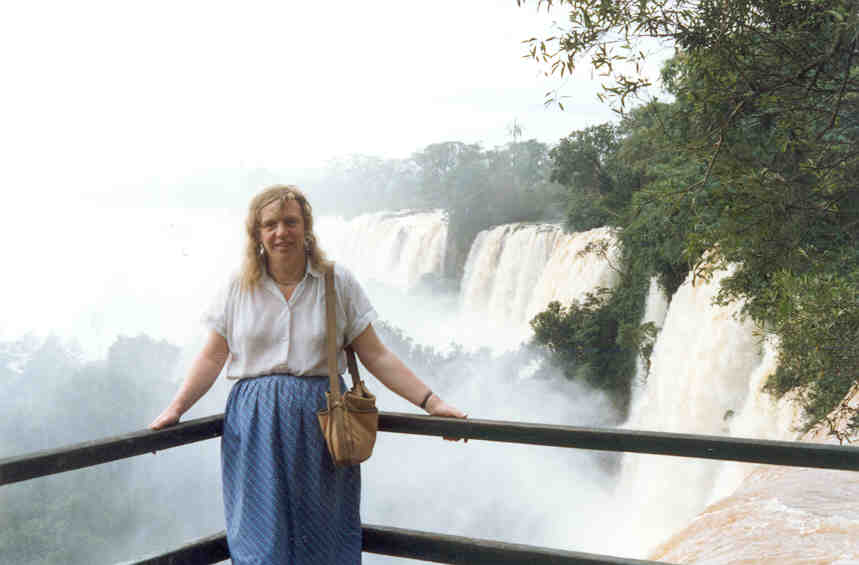
(Above: Private photo of Zagria at Iguazu Falls in 1989)A site about transgender history
How did you come up with the idea of starting a site about transgender history?A major influence was Kay Brown’s Transsexual, Transgender, and Intersex History web site. I quickly noticed the narrow range, but thought that the basic idea was good. I had made an
HTTRACK [web site copier] copy so could still refer to it when it was taken down.
Now of course it is
available to all via the Wayback Machine.
I cannot help thinking that finding information about all these transgender and nonbinary people, and writing about them, must require a lot of research. How do you identify the people you are writing about, and where do you find the information you need?Yes, a lot of research indeed. Basically I read widely. Sometimes while researching A, I encounter B, and follow up B and encounter C. I find inspiration from books, news articles, academic journals, academic theses, the internet, gossip, history, transphobic sites etc.
It is nice to discover someone while reading a book not about trans history at all. Such as
Dudley Clarke, whom I discovered in a biography on the mid-twentieth-century popular novelist Dennis Wheatley,
Charlotte Bach whom I discovered in Colin Wilson’s Mysteries, or the trans candidates for being
Jack the Ripper.
There is a lot more information out there than there was 13 years ago. Google even suggests which books discuss a person or topic. However the amount of data is itself a growing problem, and results in a lot of reading before I can write something.
Access to journals
As I am not associated with a university, access to journals was a problem. An academic friend allowed me to use his library ID and I was thereby able to access journals until he retired and the ID stopped working.
However these days almost all journals and even many books are available via TransReads, LibGen, Academia.edu, ResearchGate, Erudit, etc. Increasingly academic theses are available online, and older ones were available – until recently – at the UCalgary Gay, lesbian, Bisexual, Queer, Transgender & Two Spirit Info Site (
Archive).
I was frustrated when Google News was restricted. However we now have the
Digital Transgender Archive which would be worthwhile for the issues of
Drag Magazine alone, but has so much more.